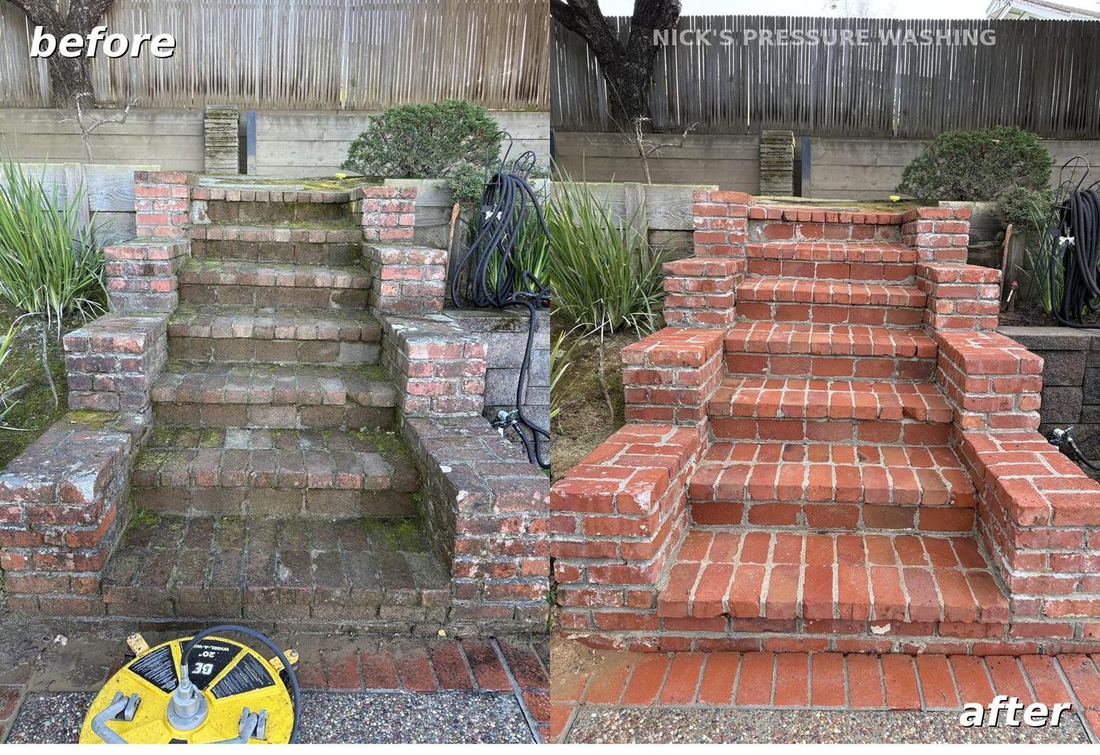
A properly installed brick patio, paver driveway, or exposed aggregate walkway can easily last 50 years. But walk around any Peninsula neighborhood and you'll see plenty of hardscape that looks tired after just 10. The difference almost always comes down to maintenance — or the absence of it.
The good news: these surfaces are almost always restorable. You rarely need to tear out and replace. You need to know what you're actually dealing with, and you need someone who can execute the restoration properly.
What's actually making it look bad
"Dirty" is a catch-all word that hides several different problems. Before you can fix hardscape, you have to diagnose it. On Peninsula properties, we see four main culprits:

Efflorescence — the white haze
That whitish, chalky film on brick and pavers isn't dirt. It's mineral salts that have migrated to the surface and crystallized. Efflorescence is caused by moisture traveling through the masonry, picking up salts from the mortar or substrate, and depositing them on the surface as the water evaporates.
Efflorescence doesn't rinse off with water. It has to be chemically neutralized with an appropriate acid-based cleaner — and the underlying moisture problem needs to be identified, or it'll come right back.
Organic growth in the joints
The sand and mortar joints between bricks or pavers are where algae, moss, and weeds establish themselves first. Once growth takes hold, it spreads into the surrounding surface and starts breaking down the joint filler itself.
This one's particularly common in shaded Peninsula neighborhoods — Burlingame, Hillsborough, anywhere with heavy tree cover.
Deep-set surface dirt and oil
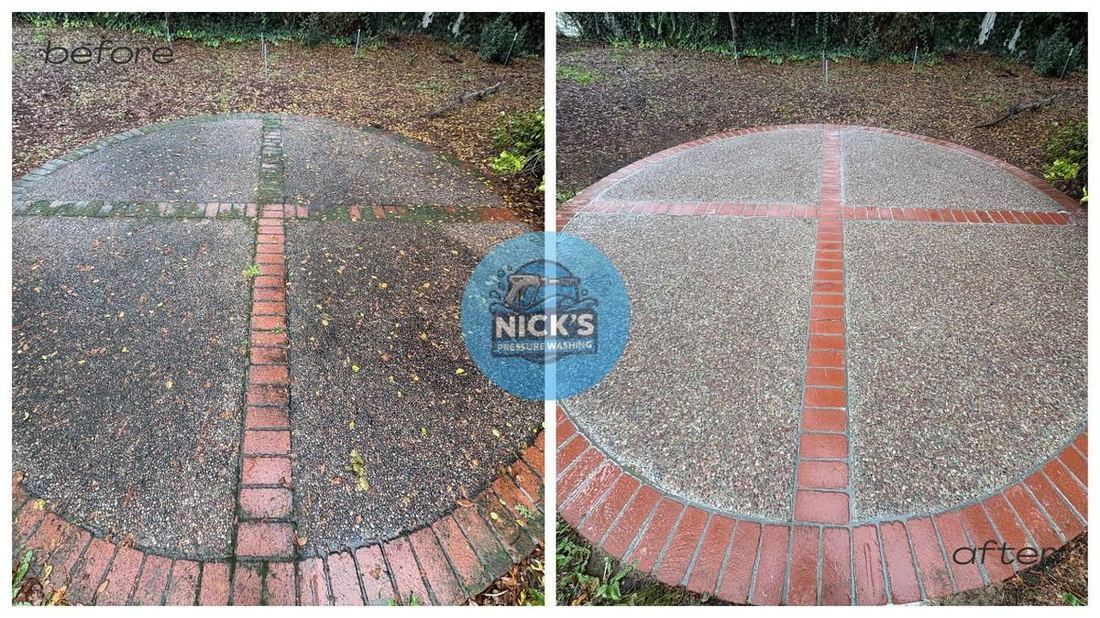
Porous materials (most brick, much stone, all exposed aggregate) absorb contaminants over time. Regular rinsing won't remove it — the dirt is in the material, not on it. This is what makes brick look gray instead of red, or makes exposed aggregate look muddy instead of clean.
Faded or failed sealers
Many pavers and some brick installations are originally sealed. Over 5–10 years, that sealer breaks down, and the surface loses both its color enhancement and its moisture resistance. The surface doesn't look damaged exactly — it just looks tired, muted, vaguely wrong.
Why DIY often makes it worse
We do a fair amount of work on hardscape that someone already tried to clean themselves. The pattern is consistent:
Home pressure washers blow out mortar
Consumer-grade pressure washers (2,000–2,500 PSI) sound modest but are plenty powerful enough to erode mortar joints and damage the surface of softer brick. The result: pitted-looking surfaces, joint erosion, and accelerated water infiltration.
Wrong detergents damage finishes
Bleach, household cleaners, and generic degreasers are not the right chemistry for most hardscape. Bleach damages colored sealers and can discolor natural stone. Acid cleaners used without neutralization etch the surface.
You can almost always tell a DIY brick cleaning job. The joints look chewed up, the color is uneven, and there are streaks where the detergent wasn't fully rinsed.
Over-cleaning fades color
Too much pressure, too often, strips the surface layer of pavers where the color pigment lives. The result is a driveway that looks pale and washed out — permanently.
Sealer application gone wrong
Sealing is easy to do and hard to do well. Wrong product, wrong weather, wrong prep, or wrong application all result in peeling, blotchy, or hazy finishes. Redoing it means stripping the bad sealer first.
The professional restoration process
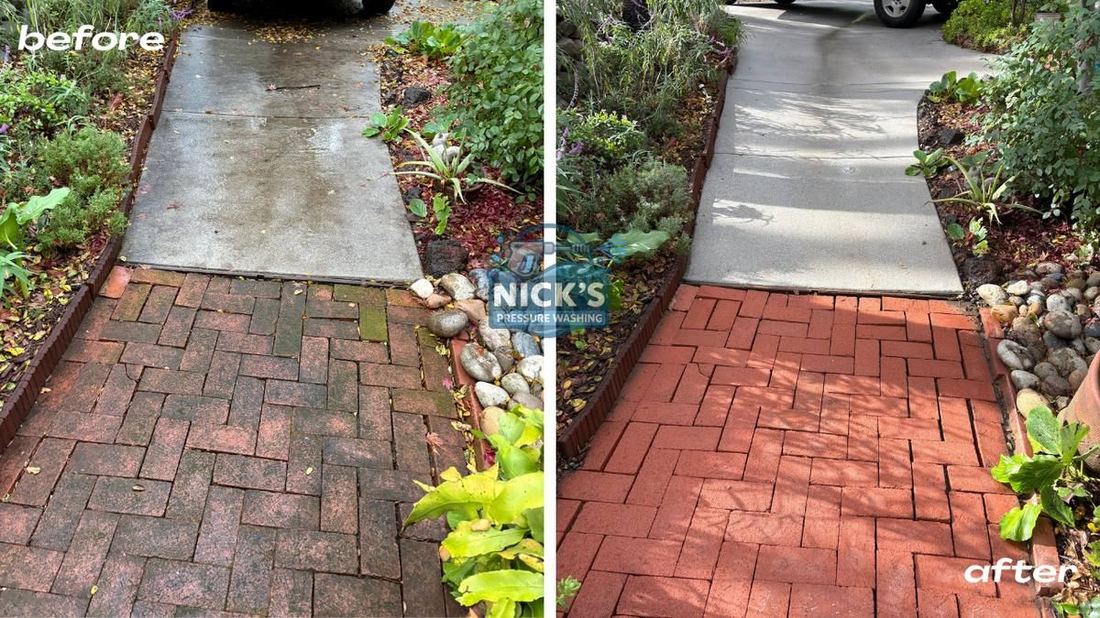
Here's what proper hardscape restoration actually looks like:
1. Assessment
Before anything else, we walk the site and identify what's actually wrong. Efflorescence needs different treatment from algae. Oil stains need different treatment from dirt. Getting this right at the start determines whether the cleaning works.
2. Pre-treatment
Appropriate detergents are applied to dwell on the surface — usually 10–30 minutes — breaking down contaminants at the chemical level before any pressure is applied. This is the single most-skipped step and the single biggest difference-maker.
3. Measured pressure washing
Surface cleaners (flat-bottom spinners, not wand tips) deliver even, controlled pressure across the full surface. This is what gets you an even clean, not a zebra-stripe pattern. Pressure is matched to the specific material.
4. Joint sand replacement (for pavers)
Any pressure washing removes joint sand. It needs to be replaced — ideally with polymeric sand, which binds in place and resists future weed growth.
5. Optional: Sealing
Once the surface is clean and dry, a proper penetrating sealer (for brick) or enhancing sealer (for pavers) locks in color, resists future staining, and dramatically extends the time between cleanings.
What to expect from the results
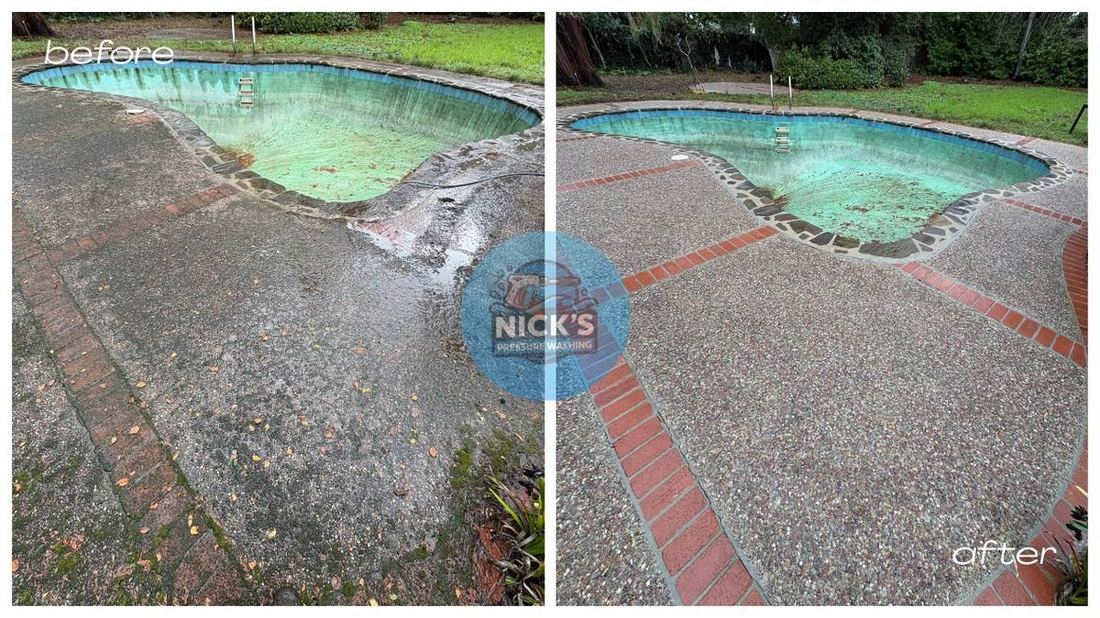
- Immediate visual restoration: 80–95% of the original appearance on most surfaces
- Time between cleanings: 2–3 years without sealer, 5–7 years with a quality sealer
- Structural benefits: Joint sand replacement and sealer application extend the life of the installation significantly
- Efflorescence: Typically fully removable, though root cause (moisture) may need to be addressed
When replacement is actually the answer
Hardscape restoration works on about 95% of the tired surfaces we see. The exceptions:
- Severe settling or structural failure — no amount of cleaning fixes a sunken patio
- Widespread spalling on brick that's been freeze-thaw damaged
- Concrete with deep cracking that's compromising drainage
- Sealer failures that have penetrated multiple layers down
Even in these cases, restoration is worth trying first. We'll tell you honestly when a surface is past the point of cleaning help — but that's rarer than most homeowners expect.
If your brick, pavers, or exposed aggregate is looking tired, we're happy to come out and assess it. No pressure to book, no sales pitch — just an honest read on whether it's restorable and what that looks like.