Forecast figures current as of NOAA’s October 8, 2026 update. NOAA’s seasonal outlook refreshes October 15 and its next El Niño discussion is November 12; we’ll update this page after each.
Every few years a winter gets a name before it arrives. This one has one already — “super El Niño” in the headlines, “historic” in NOAA’s own language — and the phone has started ringing with the same question in different words: how bad is it going to be, and what should I do about the house?
Here is the short version, and then the long one.
The El Niño is real and very strong. Whether that becomes a wet winter on the Peninsula is likely but not certain — NOAA puts the coast at 50–60% odds of above-normal rain, independent researchers put it above 90%.
The storms that actually flood San Mateo County don’t need El Niño. The worst recent ones — New Year’s Eve 2022, February 2024 — came in La Niña and weak-signal years. So the preparation case doesn’t depend on the forecast being right.
The deadline is late October. El Niño’s signal peaks in January–February, but the Bay Area’s first real storm comes in late October or November regardless. Gutters, downspouts, roof debris and drains should be done by then, then re-checked after the first atmospheric river.
What NOAA is actually saying
It’s worth separating two things that get mashed together in news coverage: how strong the El Niño is, and how much rain it will bring here. The first is about as certain as seasonal forecasting gets. The second is a tilt, not a lock.
On strength: NOAA’s Climate Prediction Center has had an El Niño Advisory in effect through its October 8 update, reports the event “continues to strengthen,” and gives better than an 83% chance it stays strong-to-very-strong through January–March 2027. Its own word for what this could become is “historic” — an event exceeding every El Niño since 1950. UCLA climate scientist Daniel Swain wrote on October 12 that it is “the strongest on record by almost any metric.” Governor Newsom proclaimed a statewide El Niño preparedness state of emergency on September 21.
On rain: NOAA’s September seasonal outlook gives the California coast its highest odds — 50 to 60 percent — of above-normal precipitation for December–February and January–March. That is a meaningful lean toward wet. It is not a guarantee, and NOAA says so: the chances of El Niño impacts are “larger, though not guaranteed.” Swain’s research-model view is far stronger — over 90% odds of a wetter-than-average winter statewide, with the Bay Area inside his highest-confidence zone — while the local National Weather Service office has been careful to describe the Bay Area as a “transition zone” where the El Niño signal is weaker than in Southern California.
Read those together and the honest summary is: a wet winter is more likely than not, a very wet one is more likely than usual, and nobody serious is promising either.
Will it really hit the Peninsula? What the last three big ones did
The most useful thing you can know about El Niño and the Bay Area is that very strong events have produced both the second-wettest season in San Francisco’s 177-year record and a perfectly ordinary one.
| Winter | Downtown SF rain | vs. 22.9″ normal | What happened |
|---|---|---|---|
| 1982-83 very strong El Niño | 38.2″ | ~167% | Jan 1982 storm (just before) triggered 18,000+ Bay Area landslides; wet winter followed |
| 1997-98 very strong El Niño | 47.2″ | ~206% | 2nd-wettest since 1849. 119 rain days. Feb 1998: 14.9″ in SF; San Francisquito Creek flooded 1,700 properties |
| 2015-16 very strong El Niño | 23.3″ | ~102% | The “Godzilla” El Niño. Storm track went north; Bay Area got a normal year |
| 2022-23 La Niña | 34.2″ | ~149% | Six atmospheric rivers in 23 days. San Mateo got 4–5″ on Dec 31 on a 1″ forecast |
Look at the last row. The storm sequence that flooded San Mateo Creek at El Camino Real, put Belmont Creek over its banks on four separate January days, and gave SFO its wettest 23-day stretch on record happened in a La Niña winter. February 2024’s hurricane-force gusts and 300-plus landslides statewide came during a modest El Niño that left San Francisco only slightly above normal for the season.
The reason is atmospheric rivers. A 2025 Scripps study found they supply up to 65% of Northern California’s annual rain, and that about a third of El Niño and La Niña years since the 1950s didn’t follow the script — mostly because of how many atmospheric rivers showed up. In the words of one of the authors, “Atmospheric rivers don’t dance to the tune of ENSO.” El Niño raises the odds that more of them come, and this year’s record-warm ocean means the ones that do come may carry more water. But a single well-aimed one in any winter is enough to overwhelm a clogged downspout.
That’s the whole argument for getting the house ready, and it doesn’t depend on El Niño doing what the headlines say.
When does it start, and when’s the deadline?
Two timelines matter. The first is El Niño’s: its storm-track signal usually doesn’t show up until December and is strongest in January and February, with the risk running through March. Autumn rain, or the lack of it, tells you nothing about what’s coming.
The second is the Bay Area’s ordinary calendar, which doesn’t wait for El Niño:
| Month | SF average rain | What it means for your house |
|---|---|---|
| October | 0.9″ | Last dry window. First atmospheric river often lands in the last week. |
| November | 2.6″ | Leaf drop peaks. Gutters that were clean in October are not clean now. |
| December | 4.8″ | Wettest month on average. King tides Dec 22–25 stall bayside drainage. |
| January | 4.4″ | El Niño signal strongest. 1998’s January: 12.1″. |
| February | 4.4″ | 1998’s February: 14.9″, a record that still stands. |
Last year’s first atmospheric river arrived on October 22. When it did, the National Weather Service told the Bay Area to “take it as a gateway to winter” and clear the gutters before the bigger storms. That’s the right instinct, one storm late.
So the practical deadline is the end of October. Get gutters, downspouts, roof valleys and yard drains cleared now, while everything is dry and the ladder work is safe. Then re-check after the first real storm, because November’s leaf drop will refill a gutter under a big oak or eucalyptus in weeks. Homes under redwoods, which shed needles all fall, usually need a second clearing in mid-winter.
Watch what’s coming
This map is live. The first tab shows real precipitation radar over the Peninsula right now; the second shows the forecast rain for the next ten days. When a band is sitting off the coast and moving east, that’s your window to check the downspouts closing.
Live weather radar centered on Burlingame, from Windy. Loads on demand so it doesn’t slow the page.
Map data: Windy.com (radar: NOAA/NWS; forecast: ECMWF). For official warnings, use the National Weather Service Bay Area at weather.gov/mtr and sign up for SMC Alert.
What one clogged downspout does in a three-day storm
People picture a clogged gutter as water splashing over the edge. What it really is, during a multi-day atmospheric river, is a redirect: an entire roof section’s runoff, delivered to one spot at the base of the house, for days.
The U.S. Department of Energy’s building-science guide describes the chain plainly. Roof runoff that isn’t carried away “can quickly saturate the soil surrounding the building and wick through the foundation,” leading to mold and rot; expansive clay soils swell and “put extreme pressure on foundations”; and where roof edges meet walls without proper flashing, overflow “runs down the wall,” damaging siding and windows. On the Peninsula, that translates into the calls we get every January:
- Fascia rot. Overflow runs over the back of the gutter and soaks the painted wood it’s hung on. Two or three wet winters and the fascia is gone, and replacing it means pulling the gutter too.
- Crawlspace and garage water. A downspout is supposed to put roof water at least five feet from the house. A blocked one puts it at the foundation. On hillside lots in Hillsborough, the Millbrae hills and upper Burlingame, that water finds the garage or the lower level.
- Buried drain failures. Many Peninsula downspouts tie into underground pipes because the lot can’t meet the code’s grading rule (six inches of fall in the first ten feet). Those lines clog with leaves, silt and roots, and the symptom is water backing up and spilling out at the downspout base. The test is simple: run a hose into the downspout and watch where the line is supposed to come out.
- Sag and separation. A gutter full of wet debris is heavy. Hangers pull, seams open, and the gutter starts holding water permanently.
The Peninsula checklist, in order of effort
This weekend, no ladder required
- Walk the downspouts. Every one should discharge onto a splash block or extension that carries water at least five feet from the foundation. If one just ends at the dirt, add an extension — it’s a ten-dollar fix.
- Find your yard drains and clear the grates. Leaves and bark mat over them in a single storm.
- Hose-test any buried downspout line. If water doesn’t appear at the outlet, it’s blocked.
- Sign up for SMC Alert (San Mateo County’s emergency notifications) and check whether your home is in a flood zone at FloodSmart.gov.
- Know your sandbag site. City of San Mateo stations are open 24/7 from October 1 to April 30 (limit 10 per vehicle). The county serves unincorporated residents at four yards, including 752 Chestnut Road in Redwood City (limit 15). Millbrae has used the 600 block of Millbrae Avenue and Landing Lane. Other cities: call public works before you need them.
Before the first big storm
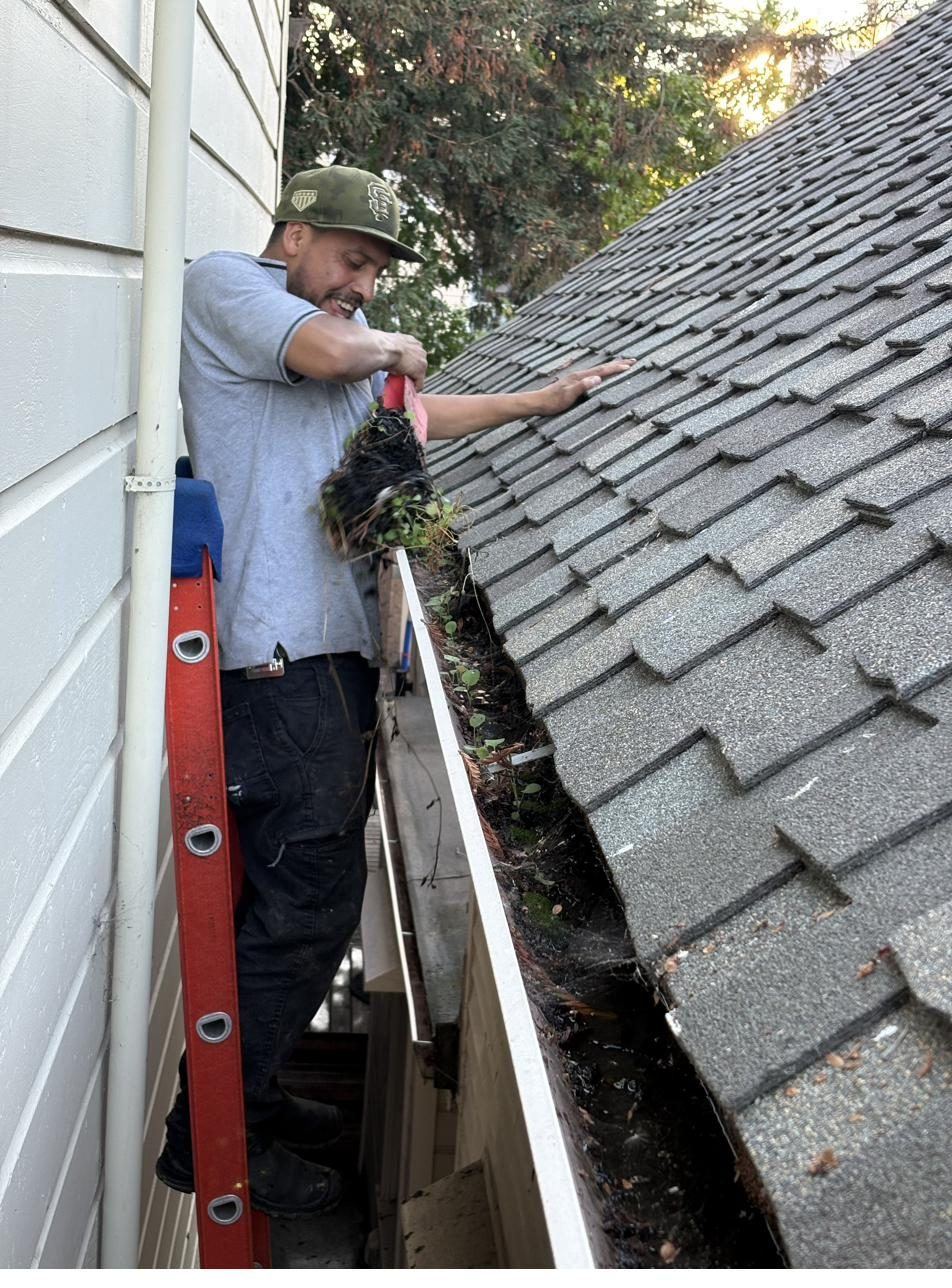
- Gutters cleared by hand, every downspout flushed until it runs clear. Blowing debris out of the open channel doesn’t touch the part that actually clogs.
- Roof valleys and behind chimneys cleared. Debris packs there like it does in gutters, and it backs water up under the shingles.
- Roof moss treated before it’s saturated. Moss holds water against shingles and tile all winter. It’s also what insurance companies are flagging in aerial photos. Low-pressure soft washing now, not a pressure washer, and not in the rain.
- Trees trimmed back from the roofline. Less debris in the gutters, and fewer limbs on the roof in a windstorm.
- If you’re creek-side in Burlingame, the city’s rule is that private owners must keep their section of creek clear of obstructions. Burlingame has five creeks running through it, mostly across private property.
Worth handing off
- Two-story and steep roofs. Ladder falls spike every fall. If the roof is high, steep, or wet, this is not the weekend to learn.
- Walkways, steps and driveways. The first rain on a summer’s worth of algae turns brick, aggregate and concrete into a skating rink. A hot-water surface clean before the rains is a slip-and-fall prevention job as much as a cosmetic one.
- A mid-winter re-clean under heavy canopy. Book it now for December or January; by then the phones are busy.
Burlingame calls itself the City of Trees, with century-old eucalyptus on Easton Drive and along El Camino. Hillsborough is oak and redwood from Skyline to El Camino. Millbrae’s hillside streets sit right where the fog comes over the ridge, which keeps roofs damp and moss growing. Redwoods shed needles every fall — exactly the fine debris that defeats most gutter guards. In our experience, homes under this canopy need twice-yearly gutter clearing, not once.
The insurance part nobody mentions
A clogged gutter doesn’t just cause damage; it can cause damage your policy won’t pay for. The California Department of Insurance notes that flood, earth movement and wear-and-tear are typically excluded from homeowners policies, and water damage from seepage, neglect or lack of maintenance commonly is too. Flood is a separate policy through the National Flood Insurance Program, which typically has a waiting period before it takes effect — so if you’re near a creek or in a mapped zone, that decision is a now decision, not a December one.
Two practical things follow. First, take dated photos of your gutters, downspouts and drains after they’re cleaned; Cal OES already recommends photographing valuables before storms for claims, and documented maintenance is the same idea. Second, if your insurer has sent you a roof letter — and a lot of Peninsula carriers are — see our insurance roof notice page. The before-and-after documentation we provide is exactly what they’re asking for.
One more thing, because the SF Standard quoted a Bay Area roofer saying it well: do not sign anything from someone who shows up at your door and says “El Niño is coming.” We don’t knock on doors. We’re licensed and insured, we quote in writing within 24 hours, and we’ll tell you honestly if what you have is a roofer’s job rather than ours.
Questions we’re getting
Does El Niño guarantee a wet winter on the Peninsula?
No. As of NOAA's October 8, 2026 update the event itself is near record strength, but NOAA's own precipitation outlook gives the California coast 50–60% odds of above-normal rain for December through February — a real tilt, not a lock. The 1982-83 and 1997-98 El Niños roughly doubled San Francisco's rainfall; the 2015-16 one produced a normal year. UCLA's Daniel Swain puts the wet odds much higher than NOAA does, above 90% statewide.
When will the El Niño rain actually start in the Bay Area?
El Niño's storm-track signal usually doesn't show up until December and peaks in January and February. The Bay Area's first real storm typically lands in late October or November regardless. Average San Francisco rainfall jumps from under an inch in October to 2.6 inches in November and 4.8 inches in December, so late October is the practical deadline for gutters, downspouts and drains.
Is it too late to clean my gutters in November?
No, but you are now racing the storms rather than getting ahead of them. If gutters are still full when the first atmospheric river arrives, clean them as soon as there's a dry window and plan a second clearing in mid-winter, especially under redwoods, oaks or eucalyptus.
Where do I get free sandbags in San Mateo County?
The City of San Mateo runs self-serve sandbag stations around the clock from October 1 through April 30 (limit 10 per vehicle, city residents and owners). San Mateo County offers free sandbags to unincorporated residents at four county yards (limit 15), including the Grant Corporation Yard at 752 Chestnut Road, Redwood City. Millbrae has distributed bags on the 600 block of Millbrae Avenue and on Landing Lane. Other cities: check your public works department, and sign up for SMC Alert for storm notices.
Does homeowners insurance cover damage from clogged gutters or flooding?
Usually not. The California Department of Insurance notes that flood, earth movement and wear-and-tear are typically excluded from homeowners policies, and water damage from seepage, neglect or lack of maintenance is commonly excluded too. Flood coverage is a separate NFIP policy through FloodSmart.gov, which typically has a waiting period before it takes effect. Keeping dated photos of your gutters, downspouts and drains after they're cleaned is cheap insurance of a different kind.
Do gutter guards mean I can skip cleaning for El Niño?
No. In Consumer Reports' independent testing, fine-mesh guards performed best but no product eliminated maintenance, and several surface-tension designs let water pour over the edge in heavy downpours — exactly the rate an atmospheric river delivers. Under Peninsula redwoods and pines, fine needles still accumulate on top of guards and need to be cleared.
If you’re in Burlingame, Millbrae, Hillsborough, San Mateo, Redwood City or anywhere on the Peninsula and the gutters haven’t been touched since spring, this is the window. Gutter cleaning details are here, roof moss removal here, or just call or text and we’ll get you on the calendar before the first storm.
- NOAA Climate Prediction Center, ENSO Diagnostic Discussion, Oct 8, 2026 — cpc.ncep.noaa.gov
- NOAA CPC, Long-Lead Seasonal Outlook, Sept 17, 2026 — cpc.ncep.noaa.gov
- Daniel Swain, Weather West, Oct 12, 2026 — weatherwest.com
- Office of Governor Gavin Newsom, El Niño preparedness state of emergency, Sept 21, 2026 — gov.ca.gov
- Golden Gate Weather Services, San Francisco seasonal rainfall and 1997-98 record — ggweather.com
- Scripps Institution of Oceanography, atmospheric rivers and ENSO, Feb 2025 — scripps.ucsd.edu
- NWS Bay Area, Dec 2022–Jan 2023 atmospheric river summary — weather.gov/mtr
- U.S. DOE Building America Solution Center, Gutters and Downspouts — basc.pnnl.gov
- 2025 California Residential Code R401.3, site grading — gocodebook.com
- Cal OES, Wet Weather Defense — caloes.ca.gov
- City of San Mateo, storm preparedness and sandbags — cityofsanmateo.org
- County of San Mateo, winter weather advisory and sandbag yards — smcgov.org
- City of Burlingame, Flood Protection — burlingame.org
- California Department of Insurance, residential insurance guide — insurance.ca.gov
- Consumer Reports, gutter guard testing — consumerreports.org
- KQED, NWS Bay Area on the first atmospheric river, Oct 2025 — kqed.org
- The SF Standard, Bay Area storm-prep businesses, Sept 25, 2026 — sfstandard.com